What Size Table Base Do I Need? Restaurant Base Sizing Chart and Wobble Fixes
Match restaurant table bases to top size: spread vs top diameter rules, X vs disc vs twin bases, bar-height sizing, heavy stone tops and how to stop tables wobbling.
Short answer
At dining height, a restaurant table base should span roughly 60–70% of the top's width or diameter: a 30 in (76 cm) top usually takes a 22 in (56 cm) cross base, a 36 in (91 cm) round a 22–24 in base, and a 42 in (107 cm) round a 30 in (76 cm) base. Rectangles longer than about 48 in (122 cm) should go on twin bases, and bar-height tables need a wider or heavier base than the same top at dining height.
Those ratios are rules of thumb used across the contract trade, not a code. The real test is whether the table stays level when a guest leans on the edge — and that depends on top weight, base type, column height and the floor. This guide explains each variable.
Why do restaurant tables wobble?
There are only four causes, and most wobbling tables have more than one:
- The base is too small for the top. Lean on the edge and the top tips over the end of the base's foot.
- The floor is uneven. No floor is flat; tiles, timber and polished concrete all vary by a few millimetres across a base's footprint.
- The fixing has loosened. Wood screws in particleboard or in a timber block under a stone top work loose under daily dragging.
- The column is too tall for its foot. At bar height, the same push on the edge creates far more leverage at the floor.
Each has a different fix: size the base, level the feet, use threaded inserts and steel plates, and widen or weight the foot at bar height.
How do you size a table base to the top?
Measure the spread — the tip-to-tip span of a cross (X) base, the diameter of a disc, or the length and width of a plate — and compare it with the top's narrowest dimension.
| Top size | Dining-height base (30 in) | Counter / bar height (36–42 in) | Notes |
|---|---|---|---|
| 24 in (61 cm) square or round | 17–18 in (43–46 cm) cross or disc | 22 in (56 cm) | Café two-top |
| 30 in (76 cm) square or round | 22 in (56 cm) cross | 22–24 in (56–61 cm), heavier foot | Most common two-top |
| 24 × 30 in (61 × 76 cm) | 22 in cross | 22–24 in | Orient arms to the long axis |
| 36 in (91 cm) square or round | 22–24 in (56–61 cm) | 24–30 in (61–76 cm) | Four-top |
| 42 in (107 cm) round | 30 in (76 cm) cross | 30 in, heavy | Consider a four-leg base |
| 48 in (122 cm) round | 30–36 in (76–91 cm) or tri-column | Not advised | Five to six covers |
| 30 × 48 in (76 × 122 cm) | 22 × 30 in rectangular base or twin bases | Twin bases | Single base only if spread is long |
| 30 × 60 in (76 × 152 cm) and longer | Twin bases or A-frames | Twin bases | Set bases about ¼ of length in |
A useful cross-check: keep the overhang — the distance from the end of the base's foot to the top's edge — under about 12 in (30 cm) on a dining table, and less on a bar table.
Cross base, disc, plate, twin or A-frame?
Each base type puts its weight and its footprint in a different place.
Cross (X) bases reach furthest for their weight because their arms extend toward the top's corners. They're the most efficient base for square tops. The arms do take up floor space where chair legs and feet go, so orient them diagonally on square tables.
Disc bases keep all their weight at floor level and have no arms to trip over or catch mop strings. Because the edge of a disc is closer to the centre than the tip of a cross arm of the same "size", a disc should be heavy steel or cast iron, and can be specified slightly larger than the equivalent cross. Our Calder Round uses a weighted steel disc with a shadow-line edge so it looks slimmer than it is.
Plate bases — flat rectangular or square steel plates — behave like discs but can be aligned with a wall or banquette. Twin columns on one long plate are a strong solution for 30 × 48 in tops, as on the Banded Carrara Twin-Column Table.
Twin independent bases under long rectangles keep the floor between them open. Position them about a quarter of the top's length in from each end; that balances the span between them against the overhang at the ends.
A-frames and trestles are the natural support for communal tables 8 ft (2.4 m) and longer. A stretcher between the frames stops the table racking along its length. See the Communal Tables collection.
| Base type | Stability per weight | Knee/foot room | Cleaning | Best for |
|---|---|---|---|---|
| Cross / X | High | Arms in foot zone | Good | Square two- and four-tops |
| Disc | Medium (needs mass) | Excellent | Excellent | Rounds, tight floors |
| Plate | Medium (needs mass) | Very good | Excellent | Wall and banquette tables |
| Twin columns | High | Excellent between bases | Very good | Rectangles 48 in+ |
| Cast-iron bistro | High (heavy) | Good | Good | Fixed layouts, two-tops |
| A-frame / trestle | Very high | Good, ends open | Good | Communal tables |
| Four-leg | Highest | Legs at corners | Good | Large rounds, accessible seating |
Do heavy stone tops need bigger bases?
A heavy top actually makes a table harder to tip, as long as the base is properly fixed — the top's weight sits over the centre and resists the push on the edge. What a heavy top demands is a stronger base, not necessarily a wider one: a thicker column wall, a larger top plate, and fixings that won't pull out.
Two practical rules for stone and sintered stone tops:
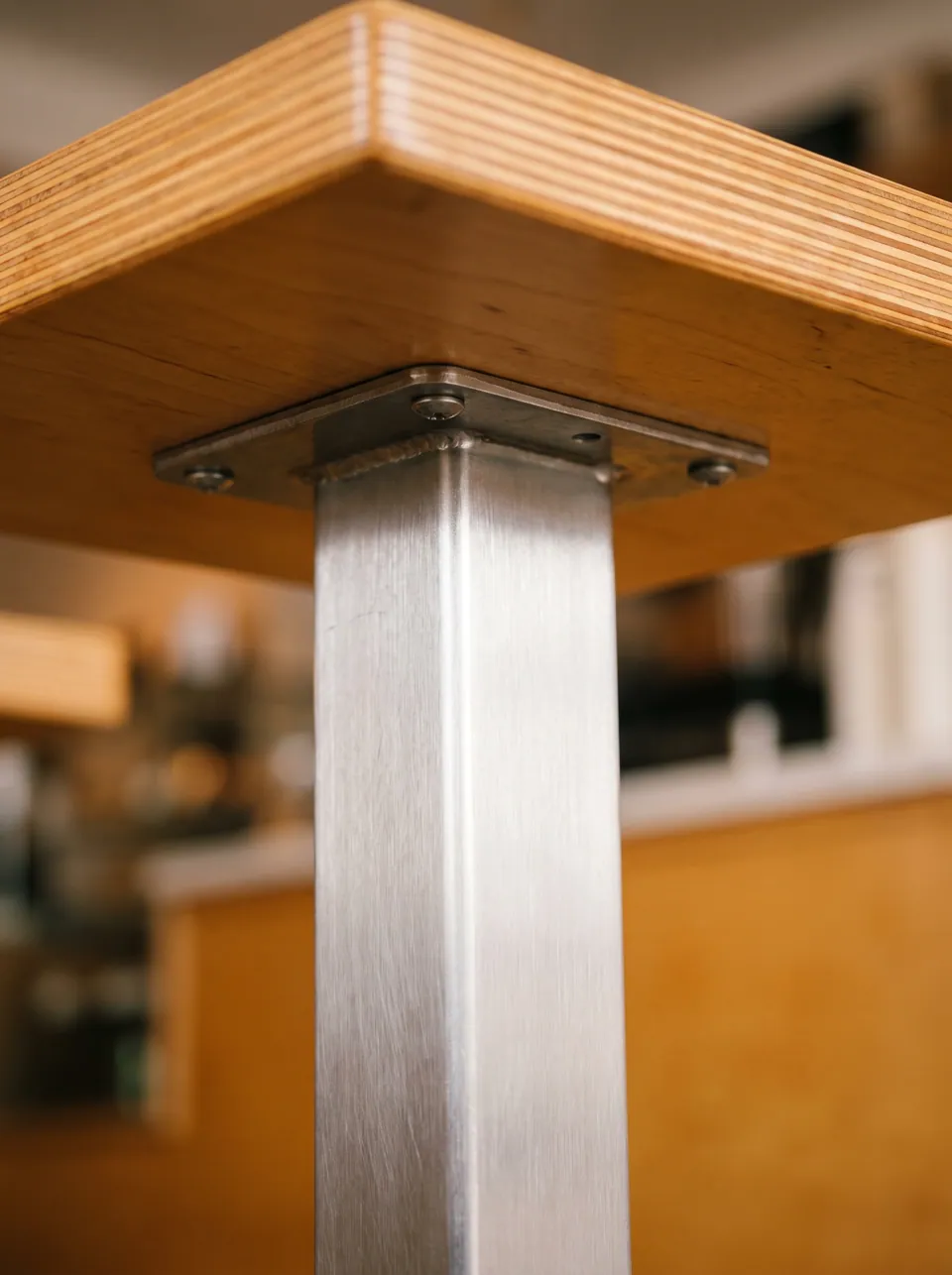
- Use a steel sub-plate or a full steel frame under the top, bonded or mechanically fixed, with threaded inserts for the base. Never screw a base into the stone itself or into a thin wood backer.
- Size the top plate of the base to the top: a small 7 in (18 cm) spider is fine under a 24 in laminate top, but a 30 × 48 in stone top needs a wider top plate or a steel rail so the slab is supported across its width.
Why do bar-height tables need wider bases?
Because a push on the edge of a 42 in (107 cm) table acts on a lever roughly 40% longer than on a 30 in table. Guests also lean on high-tops more — standing guests put their full weight on an elbow. Increase the spread, add mass to the foot, or both. A foot ring, as on the Calder Bar-Height Table, also stiffens the column and gives feet somewhere to go other than the base.
How do you stop a table wobbling on an uneven floor?
- Fit adjustable glides as standard; they take up typical floor variation of a few millimetres.
- Level on site, at the table's final position, not in the delivery area.
- Use self-levelling glides where tables move often or floors are notably uneven; several systems exist that adjust automatically when the table is placed.
- Retighten fixings after the first weeks of service; timber tops settle.
- Never use folded napkins or wedges — they slip, look poor and hide a real problem.
Specification checklist
- [ ] Top size, thickness, material and weight known
- [ ] Base spread at least 60–70% of the top's narrowest dimension (dining height)
- [ ] Wider or heavier base for counter and bar heights
- [ ] Twin bases or A-frames for rectangles over about 48 in
- [ ] Overhang from foot to edge kept under about 12 in
- [ ] Steel sub-plate or frame under stone tops; threaded inserts
- [ ] Adjustable or self-levelling glides specified
- [ ] Base footprint checked against chair legs and accessible knee/toe clearance
- [ ] Base finish suited to mopping (powder coat, PVD, sealed timber)
Common mistakes
Buying tops and bases from different suppliers without a drawing. The hole pattern, top plate and spread never quite match.
Putting a 30 × 48 in top on a 22 in square base. The ends will dip every time someone leans on them.
Using the dining base at bar height. It looks identical and behaves completely differently.
Mounting stone straight onto a wood block. The screws pull out and the joint loosens within months.
Forgetting accessibility. A centre pedestal with a wide foot can intrude into the knee and toe space required at accessible tables; see our ADA table guide.
FAQ
What size base for a 30 inch square table?
A 22 in (56 cm) cross base at dining height, oriented with its arms toward the corners. At bar height, 22–24 in with a heavier foot.
What size base for a 36 inch round table?
A 22–24 in (56–61 cm) cross base or a heavy disc of similar size. At bar height, go to 24–30 in.
When should I use two bases instead of one?
For rectangular tops of about 48 in (122 cm) and longer, or whenever the overhang beyond a single base's foot exceeds about 12 in (30 cm).
Are cast-iron bases better than steel?
Cast iron is heavier, which helps stability in a compact footprint, and suits traditional styles. Fabricated steel can be designed wider and lighter. Both work when sized correctly.
Do you supply bases for our existing tops?
On project quantities, yes — send us the top dimensions, material and fixing pattern and we'll draw a matching base.
Send your floor plan, cover count or table schedule and we'll reply with suggested sizes, top and base pairings, and a quote. Drawings first, always.
Request a quote